
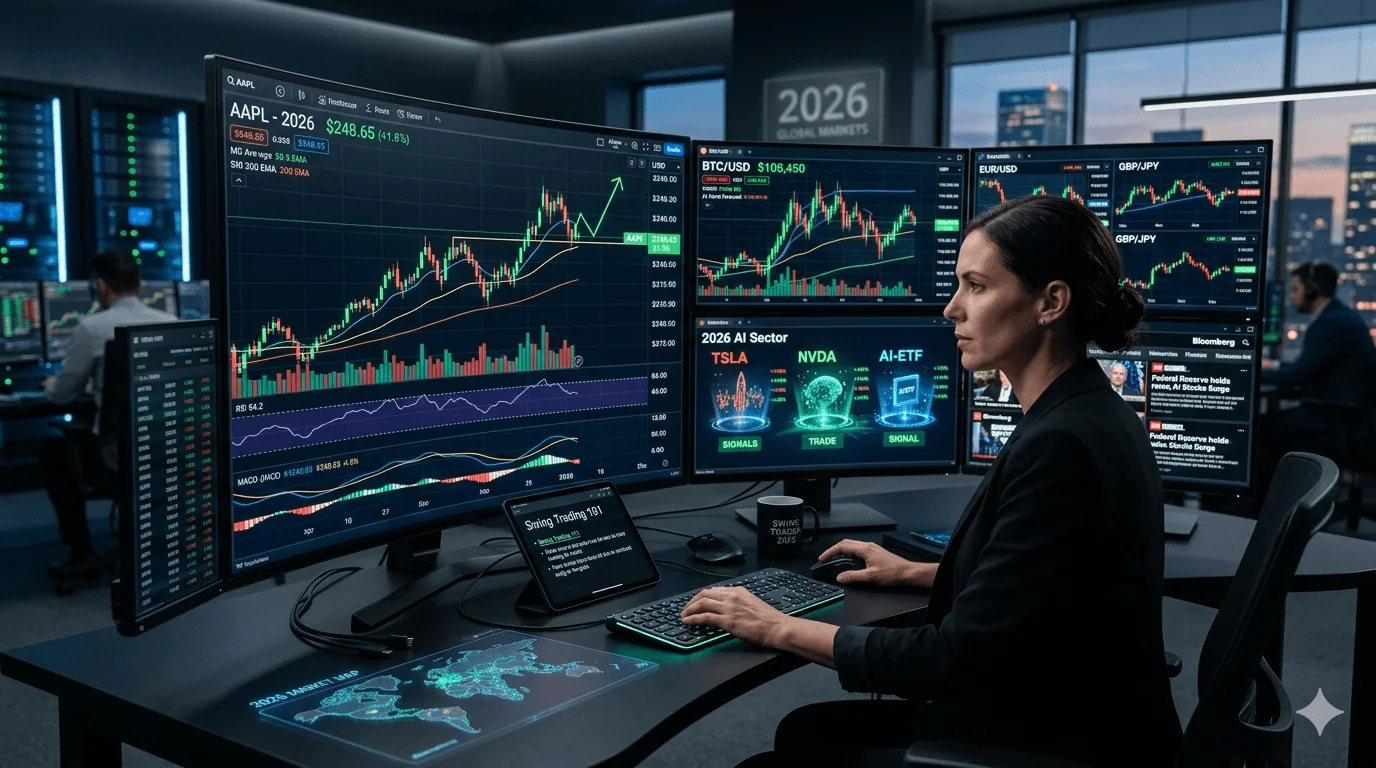
Financial markets in 2026 are moving faster than ever. Artificial intelligence stocks are surging, crypto markets are swinging wildly, and forex pairs are reacting instantly to global economic news. In this environment, swing trading has become one of the most popular strategies for traders who want to profit from short- to medium-term price movements without staring at charts all day.
Unlike long-term investing, where traders may hold positions for years, swing trading focuses on capturing price “swings” that happen over a few days or weeks. Most swing traders hold positions between two and ten trading days, although some setups may last longer depending on market conditions.
One reason many traders prefer this strategy is flexibility. Day trading often requires constant monitoring and fast execution, while long-term investing can feel too slow for people seeking more active opportunities. Swing trading sits comfortably in the middle. It allows traders to take advantage of momentum while still maintaining a regular lifestyle.
For people exploring swing trading for beginners, the strategy can feel more manageable because it relies heavily on structure and planning. Traders look for trends, wait for specific setups, define risk levels, and aim for favorable reward-to-risk ratios.
In 2026, technology has also made trading easier. Platforms like TradingView, Finviz, and SwingTradeBot now provide advanced charting tools, scanners, alerts, and AI-driven insights that help traders spot high-probability setups quickly.
However, there are risks. Markets remain unpredictable, and traders who ignore risk management often lose money. Emotional decisions, poor position sizing, and chasing hype stocks continue to destroy trading accounts every year.
This guide will explain everything you need to know, including how swing trades work, the best technical indicators for swing trading, the top strategies used by professionals, the best swing stocks in 2026, and how to manage risk effectively.
How Swing Trading Works: Core Mechanics
Understanding the mechanics behind successful trades is critical before risking real money.
At its core, the process involves identifying trends, entering positions at strategic levels, managing risk, and exiting trades for profit.
Step 1: Identify the Trend
Most profitable traders begin by identifying the market trend.
A stock trading above its 20 EMA and 50 EMA usually signals bullish momentum. A stock below those levels may indicate bearish pressure.
For example:
- Uptrend = higher highs and higher lows
- Downtrend = lower highs and lower lows
- Sideways = consolidation range
In 2026, sectors like AI infrastructure, semiconductors, cybersecurity, and energy storage have become extremely active for traders.
Step 2: Find an Entry Setup
After identifying the trend, traders look for pullbacks, breakouts, or reversals.
Common entry methods include:
- EMA pullbacks
- RSI oversold signals
- Breakout above resistance
- Fibonacci retracement bounces
A trader may wait for NVDA to pull back toward the 20 EMA before buying during an uptrend.
Step 3: Position Sizing
Professional traders never risk large portions of their account on one trade.
Most traders use the 1% rule:
- Risk only 1% of total capital per trade
- Example: $5,000 account = $50 max risk
This protects traders from major losses during losing streaks.
Step 4: Set Stop-Loss and Targets
A stop-loss automatically closes the trade if price moves against you.
Most swing traders target:
- Risk-to-reward ratio of 1:2 or higher
- Example:
- Risk = $1
- Target = $2-$3
Step 5: Manage the Trade
Trades should not be emotional.
Successful traders:
- Move stop-losses carefully
- Avoid overtrading
- Follow their trading plan
The volatility of 2026 markets makes discipline more important than ever.
Best Technical Indicators for Swing Trading

Technical indicators help traders identify trends, momentum, and potential reversals. The best traders rarely rely on a single tool. Instead, they combine multiple indicators to confirm setups.
Moving Averages
Moving averages are among the best indicators for swing trading because they help traders identify trend direction clearly.
EMA Crossovers
Popular combinations:
- 9 EMA and 21 EMA
- 20 EMA and 50 EMA
When the shorter EMA crosses above the longer EMA, bullish momentum may begin.
Example
If AMD crosses above the 20 EMA after earnings, traders may enter expecting continuation.
RSI (Relative Strength Index)
RSI measures momentum.
- Above 70 = overbought
- Below 30 = oversold
Many traders buy when RSI drops below 30 during strong uptrends.
RSI remains one of the best technical indicators for swing trading because it works across stocks, crypto, and forex.
MACD
MACD helps traders identify momentum shifts.
Bullish signal:
- MACD line crosses above signal line
Bearish signal:
- MACD crosses below signal line
MACD works especially well during trending markets.
Bollinger Bands
Bollinger Bands measure volatility.
When price touches the lower band during an uptrend, traders may look for reversal entries.
When price touches the upper band after extended rallies, profit-taking may occur.
Fibonacci Retracement
Fibonacci levels help identify support and resistance.
Popular retracement zones:
- 38.2%
- 50%
- 61.8%
Many traders buy pullbacks near these levels.
Volume Indicators
Volume confirms strength.
A breakout with high volume is more reliable than one with weak volume.
Indicator Comparison Table
| Indicator | Best Use | Strength |
|---|---|---|
| RSI | Momentum reversals | Simple and effective |
| MACD | Trend momentum | Great confirmation |
| EMA | Trend direction | Excellent for pullbacks |
| Bollinger Bands | Volatility | Identifies extremes |
| Fibonacci | Support/resistance | Precise entries |
| Volume | Confirmation | Validates breakouts |
Using multiple swing trading indicators together usually improves trade quality.
Top Swing Trade Screeners and Tools for 2026
Finding setups manually is difficult. That is why traders use a swing trade screener.
SwingTradeBot
SwingTradeBot is one of the best free tools for finding technical setups.
Features:
- Bullish scans
- EMA crossover alerts
- Chart pattern detection
- NASDAQ/NYSE scanning
Many beginner traders use SwingTradeBot because it simplifies stock scanning.
Pros
- Easy to use
- Free
- Great for beginners
Cons
- Limited customization
TradingView
TradingView is widely considered the most powerful charting platform.
Features:
- Advanced charts
- Community indicators
- Custom screeners
- AI alerts
Traders can filter:
- RSI values
- EMA setups
- Relative volume
- Trend strength
Many professional swingtrader accounts rely heavily on TradingView.
Finviz
Finviz is excellent for finding strong momentum stocks.
Popular filters:
- Relative volume
- ATR volatility
- Float size
- Technical breakout patterns
Pros
- Fast scanning
- Excellent heatmaps
- Strong stock filtering
Cons
- Advanced tools require premium access
Thinkorswim
Thinkorswim provides institutional-level trading tools.
Best for:
- Options trading
- Advanced charting
- Active traders
Best Swing Trading Strategies for 2026

The most profitable traders focus on proven systems rather than random trades.
Trend Pullback Strategy
This is among the best swing trading strategies for trending markets.
Setup
- Strong uptrend
- Pullback toward 20 EMA
- RSI cools down
- Bullish candle forms
Entry
Buy near EMA support.
Stop
Below recent swing low.
Target
Previous highs or 2R target.
Breakout Strategy
Breakouts happen when price escapes consolidation.
Example
A stock trades sideways for 10 days, then breaks resistance with volume.
Entry
Above breakout level.
Risk
False breakouts remain common.
Fibonacci Pullback Strategy
This strategy uses retracement zones for entries.
Process
- Identify trend
- Draw Fibonacci levels
- Wait for bounce near 50% or 61.8%
This method works particularly well for swing trading stocks after strong earnings runs.
Moving Average Crossover Strategy
This strategy relies on EMA crossovers.
Bullish Signal
9 EMA crosses above 21 EMA.
Bearish Signal
9 EMA crosses below 21 EMA.
Earnings Gap Strategy
In 2026, AI and semiconductor stocks often move aggressively after earnings.
Example
NVDA gaps up 12% after earnings.
Traders wait for consolidation before entering continuation trades.
Sector Rotation Strategy
Money rotates between sectors constantly.
In 2026:
- AI stocks dominate during tech rallies
- Utilities attract defensive money
- Energy rises during oil spikes
Sector rotation traders follow institutional flows.
Strategy Comparison Table
| Strategy | Best Market | Risk Level |
|---|---|---|
| Pullback | Trending | Moderate |
| Breakout | Momentum | High |
| Fibonacci | Technical | Moderate |
| EMA Crossovers | Trending | Low |
| Earnings Gap | Volatile | High |
Swing Trading Stocks: Best Picks and Selection in 2026
Finding the right stocks is essential for profitability.
What Makes Good Swing Stocks?
Strong candidates usually have:
- High liquidity
- Good volatility
- Strong trends
- Heavy trading volume
These characteristics help traders enter and exit easily.
Best Stocks to Swing Trade in 2026
| Stock | Sector | Why Traders Like It |
|---|---|---|
| NVDA | AI/Semiconductors | Massive volatility |
| TSLA | EV | Large daily moves |
| AMD | Chips | Strong momentum |
| META | Tech | Trending breakouts |
| ARM | AI chips | Volatile growth |
| AAPL | Technology | Reliable trends |
| MSFT | Cloud/AI | Strong institutional support |
| PLTR | AI/Data | Momentum setups |
| SMCI | Servers | Explosive price swings |
| COIN | Crypto | Bitcoin correlation |
Nvidia (NVDA)
Nvidia remains one of the top swing trading stocks due to AI demand and volatility.
Read this detailed guide: Nvidia Stock Guide: NVDA Price, Earnings & Projections
Tesla (TSLA)
Tesla continues producing large swings due to:
- EV demand
- AI robotaxi news
- Earnings volatility
AMD
AMD frequently creates strong breakout opportunities after earnings reports.
These are ideal good swing trade stocks because they move enough to create opportunity while remaining liquid.
Swing Trading Options, Crypto, and Forex
Swing Trading Options
Swing trading options can amplify returns dramatically.
Popular Strategies
- ATM call buying
- Bull call spreads
- Put buying during downtrends
Risks
- Theta decay
- Implied volatility crush
- Rapid losses
Options require strict risk management.
Platforms like Thinkorswim help traders manage options positions effectively.
Swing Trading Crypto
Swing trading crypto has exploded in popularity.
Popular assets:
- Bitcoin
- Ethereum
- Solana
Crypto traders often use:
- RSI
- EMA pullbacks
- Volume analysis
Because crypto trades 24/7, volatility remains extremely high.
Platforms like Binance and Coinbase dominate crypto trading activity.
Forex Swing Trading
Forex swing setups remain popular due to leverage and liquidity.
Popular pairs:
- EUR/USD
- GBP/USD
- USD/JPY
Common Tools
- Moving averages
- Support/resistance
- Economic calendars
Swing trading forex requires awareness of central bank news and global macroeconomic trends.
Platforms like MetaTrader 5 remain industry standards.
Swing Trading for Beginners: Step-by-Step Guide
Getting started does not require massive capital.
Step 1: Choose a Broker
Popular brokers include:
Step 2: Start Small
A beginner might begin with:
- $2,000-$5,000 account
- One or two trades weekly
Step 3: Create a Watchlist
Focus on:
- AI stocks
- Semiconductor stocks
- High-volume ETFs
Step 4: Use a Trading Plan
Every trade should include:
- Entry
- Stop-loss
- Target
- Position size
Step 5: Practice Risk Management
The best traders survive losing streaks because they control risk carefully.
Common Beginner Mistakes
- Overtrading
- Ignoring stop-losses
- Chasing hype
- Trading without setups
For people learning swing trading for beginners, consistency matters more than speed.
Risk Management and Psychology in Swing Trading
Technical skills alone are not enough.
Psychology often separates winners from losers.
Position Sizing
Never risk too much on one trade.
Professional traders survive because they preserve capital.
Avoiding FOMO
Fear of missing out destroys discipline.
Many traders buy extended breakouts late and suffer losses.
Keep a Trading Journal
Track:
- Entry reasons
- Emotions
- Results
- Mistakes
This helps identify patterns.
Adapt to Volatility
2026 markets can reverse rapidly because of:
- AI headlines
- Fed decisions
- Crypto volatility
- Geopolitical events
Adaptability matters.
Conclusion
Markets in 2026 continue creating incredible opportunities for disciplined traders. From AI stocks to crypto momentum and forex trends, there are more active setups than ever before. However, success in swing trading does not come from luck. It comes from preparation, patience, and proper risk management.
The best traders focus on:
- Strong setups
- Risk control
- Emotional discipline
- Consistent strategies
Whether you are exploring swing trading for beginners, searching for the best stocks to swing trade, or learning advanced indicator combinations, the key is starting with a structured plan.
Use powerful tools like TradingView, Finviz, and SwingTradeBot to scan markets efficiently and identify quality setups.
Start small, use a demo account if needed, and focus on consistency instead of quick profits. Over time, strong habits and disciplined execution can turn swing trading into a reliable skill.
FAQ
1. What is swing trading?
Swing trading is a strategy where traders hold positions for several days or weeks to profit from short-term price movements.
2. What are the best indicators for swing trading?
Popular indicators include RSI, MACD, moving averages, Bollinger Bands, Fibonacci retracements, and volume analysis.
3. Which stocks are best for swing trading in 2026?
Top choices include NVDA, TSLA, AMD, META, ARM, and other volatile AI-related stocks.
4. Is swing trading better than day trading?
Swing trading generally requires less screen time and may feel less stressful than day trading, although both involve risk.
5. Can beginners start swing trading?
Yes. Many traders begin with small accounts and use demo platforms before risking real capital.
6. What is the best swing trade screener?
Popular choices include Finviz, TradingView, and SwingTradeBot.
7. Is swing trading profitable in crypto markets?
It can be profitable because crypto markets are highly volatile, but risks are also significantly higher.
How much money do I need to start swing trading?
Many beginners start with $2,000-$5,000, although smaller accounts are possible with proper risk management.

